Workshop roots
The heritage story begins with professional hand tools and a clear attention to pliers as a serious trade instrument.
Heritage and manufacturing discipline
Knipex is presented here as a focused hand-tool authority: a brand for buyers who evaluate pliers by jaw alignment, forged steel quality, cutter geometry and the way a handle behaves through a long shift. The story centers on German-style manufacturing discipline, controlled tool families and trade-specific catalog clarity rather than a broad lifestyle message. The result is a company narrative that supports a purchasing decision: why this product line belongs in a professional tool room, a distributor counter or a service technician's kit.
Tool-room logic
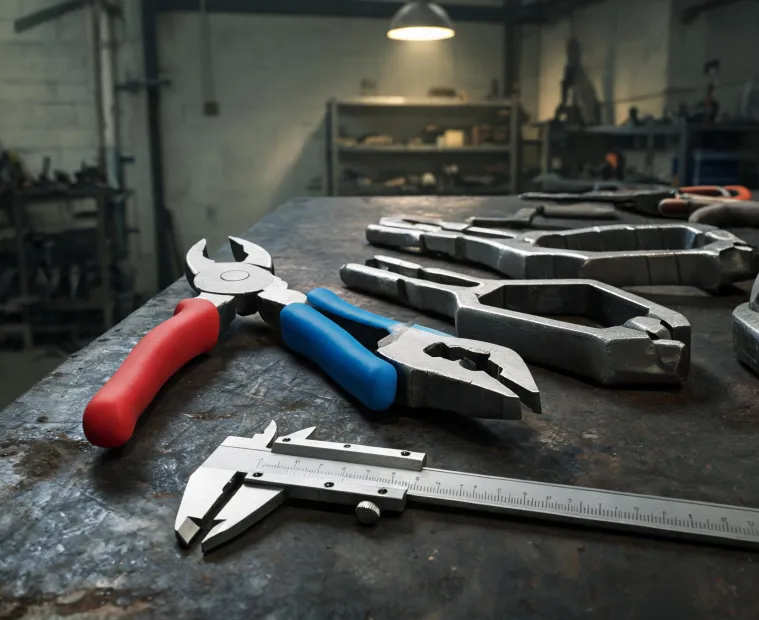
The strongest signal in the Knipex story is specialization. Instead of treating every hardware category as equal, the brand centers its authority on pliers, cutters, wrenches, insulated tools and related hand-tool systems. That narrow focus matters to a buyer because similar-looking tools can behave very differently under pressure. A smooth jaw can protect a plated fitting; a gripping jaw can hold a worn pipe; a long cutter can reduce hand strain on repeated cable work.
This site uses that logic across the catalog. Product families are framed by use case, not by decorative merchandising. Service pages ask for the workpiece and the trade. Engineering content explains how a tool standard changes downtime, fitment at the bench and stocking consistency. The same idea shapes the visual design: straight edges, technical tables, compact cards and dark navigation that feels closer to a trade catalog than a consumer brochure.
Timeline
The heritage story begins with professional hand tools and a clear attention to pliers as a serious trade instrument.
Tool families expand around water pump pliers, cutters, crimping tools and insulated models for distinct job conditions.
Distributor and jobsite buyers need clearer families, more precise names and practical comparisons between similar tools.
Knipex-facing content helps teams map grip, finish protection, clearance and kit format before they send a purchase request.
People behind the standard
Translate jaw geometry, handle load and cutting-edge behavior into selection notes that buyers can use.
Listen for the exact field condition: pipe access, panel work, wire size, fitting finish or tool-pouch constraints.
Organize line-card choices for counter teams that need quick answers without bloating shelf inventory.
Keep replacement discussions grounded in wear marks, model identification and documented application context.
Use the contact form to describe the trade, tool family and stocking goal, then request a practical recommendation.
Talk to Tool Support